No, not that F-word, I’m talking about feelings.
How we feel is a huge part of how we handle change. And, as we are all experiencing, change is uncertain, it’s everywhere, and it’s speeding up.
We are emotional beings, yet there is still a huge bias towards using only rational approaches to manage organisational change. It’s high time we changed this.
Imagine this increasingly common scenario: you’re about to announce a major organisational change, with a strong strategic rationale, but it will result in significant disruption and a focus on cost reduction. The atmosphere is tense, and you can sense the anxiety among colleagues as they wonder how it will affect them.
Now imagine how different it would be if you could channel that nervous energy into curiosity and creativity, unlocking the ideas and energy of colleagues to solve the problems the organisation faces and achieve the desired outcomes with less stress and disruption.
This is not wishful thinking; rather, it is the opportunity that comes from understanding the role of emotions in change.
The impact of emotions on culture
Research reveals that beneath our carefully crafted people policies lies a powerful force: emotional culture. This encompasses the shared affective values, norms, and assumptions that govern the emotions people have and express at work.
“Every organisation has an emotional culture, even if it’s one of suppression” Sigal Barsade |
Emotional culture makes a significant impact in many areas critical to organisational success:
- Team dynamics: emotions are contagious, influencing collaboration and creativity across the organisation, for better or worse
- Decision making: our emotional state significantly influences judgment and risk assessment
- Employee engagement: a positive emotional culture fosters a deeper connection to colleagues and our work, increasing discretionary effort and reducing turnover
- Change readiness: emotions like curiosity and confidence can drive innovation and adaptability, while fear and anxiety can hinder progress
- Employer brand: in a competitive talent market, the emotional experience of working for your organisation can be a key differentiator
There’s a lot at stake. According to the State of the Global Workplace: 2024 Report, workplaces globally aren’t providing the elements employees need to thrive at their jobs. That might be why many employees feel lonely, angry, stressed or are looking for another job.

Contrasting outcomes of positive and negative emotional cultures
Think about the very best teams or organisations you have worked in. How did it make you feel?
Did you love going to work, and feel you belonged and were valued? Or did you feel a sense of anxiety, low energy, and not enjoy your job?
Now imagine multiplying those emotions across a whole workforce, and the pay-off for getting this right is huge. And so is the cost of getting it wrong.
Not surprisingly, there are very different outcomes when companies manage emotions well in the workplace and when they don’t.
Positive emotional cultures tend to experience:
- Improved teamwork and collaboration
- Increased problem-solving abilities
- Higher creativity and innovation
- Accountability and reliability
- Higher productivity
- Authenticity and integrity
- Better communication
- Greater resilience in the face of challenges
- Lower absenteeism and turnover
- Higher employee engagement
- Healthy organisational culture with a sense of safety, trust and inclusivity
Negative emotional cultures often lead to:
- Dysfunctional teams, no collaboration
- Low motivation and discretionary effort
- Risk aversion and lack of new ideas
- Lack of urgency and accountability
- Greater resistance to change
- More workplace conflict
- Inattention to detail and lower quality
- Low resilience and higher risk of burnout
- Higher absenteeism and turnover
- Low employee engagement
- Unhealthy organisational culture, often characterised by anxiety or fear
The key to high-performing teams and organisations is their ability to intentionally create a positive emotional culture in which people can thrive.
The 5-step SHIFT framework to create a positive emotional culture
When we work with teams and organisations to help them successfully navigate change, we use our 5-step SHIFT framework to create positive and change-ready emotional cultures.
Here’s how you can put this approach to good use:
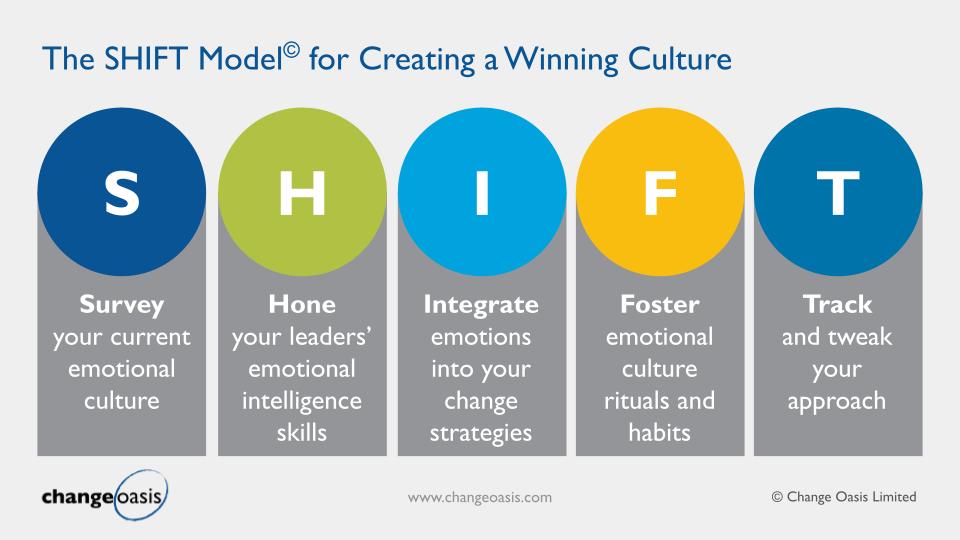
S – Survey your emotional culture
Conduct a comprehensive assessment and map your organisation’s current and desired emotional culture:
- Identify the current emotional climate across different levels and departments
- Explore how leadership behaviours influence the current emotional culture
- Map the emotional culture that you need to create to be successful
H – Hone leaders’ emotional intelligence
Invest in enhancing the emotional intelligence of your leaders:
- Increase leaders’ self-awareness of their emotions and their impact on others
- Improve their ability to recognise and respond to team members’ emotions
- Encourage leaders to model desired emotional states and teach them techniques for emotional regulation during high-stress periods
I – Integrate emotions into change strategies and stories
When planning change initiatives, explicitly consider the emotional dimension:
- Identify the key emotions that will drive successful change in your context
- Develop strategies to cultivate these emotions throughout the change process and create action plans for addressing potential emotional barriers
- Share stories about change successes and overcoming challenges which have emotion at their heart
F – Foster emotional çulture habits and rituals
Guide teams in creating practices that reinforce positive emotional states:
- Co-create team rituals that cultivate desired emotions (eg gratitude sharing)
- Establish emotion check-ins at the beginning of meetings and regular retrospectives to understand how people are feeling
- Develop peer support systems for managing undesirable emotions
T – Track and tweak your approach
Establish a continuous improvement cycle for your emotional culture initiatives:
- Integrate emotional metrics into existing performance and engagement surveys
- Hold leadership reflection sessions to review progress and adjust strategies
- Provide ongoing support to help leaders refine their emotional leadership skills
”People will forget what you said, people will forget what you did, but people will never forget how you made them feel.” Maya Angelou |
Do you need to shift the way you feel at work?
While navigating the complexities of emotional culture can be challenging, the potential benefits to employee engagement, change readiness, and overall organisational performance are huge.
Thinking about your organisation’s emotional culture, consider:
- What emotions currently dominate your workplace?
- How confident are you that you have the right emotional culture to support your organisation’s strategic objectives?
- If you don’t feel confident, how big a risk is that to your future success?
Emotions are a critical driver of success in today’s dynamic work environment. By addressing these questions and implementing the SHIFT strategies outlined above, you can begin to bridge the gap between your current and desired emotional culture, unlocking new levels of performance, engagement, and organisational health.
Time to embrace the F-word in your workplace?
Your employees – and your bottom line – will thank you for it.